The Il Mulino story
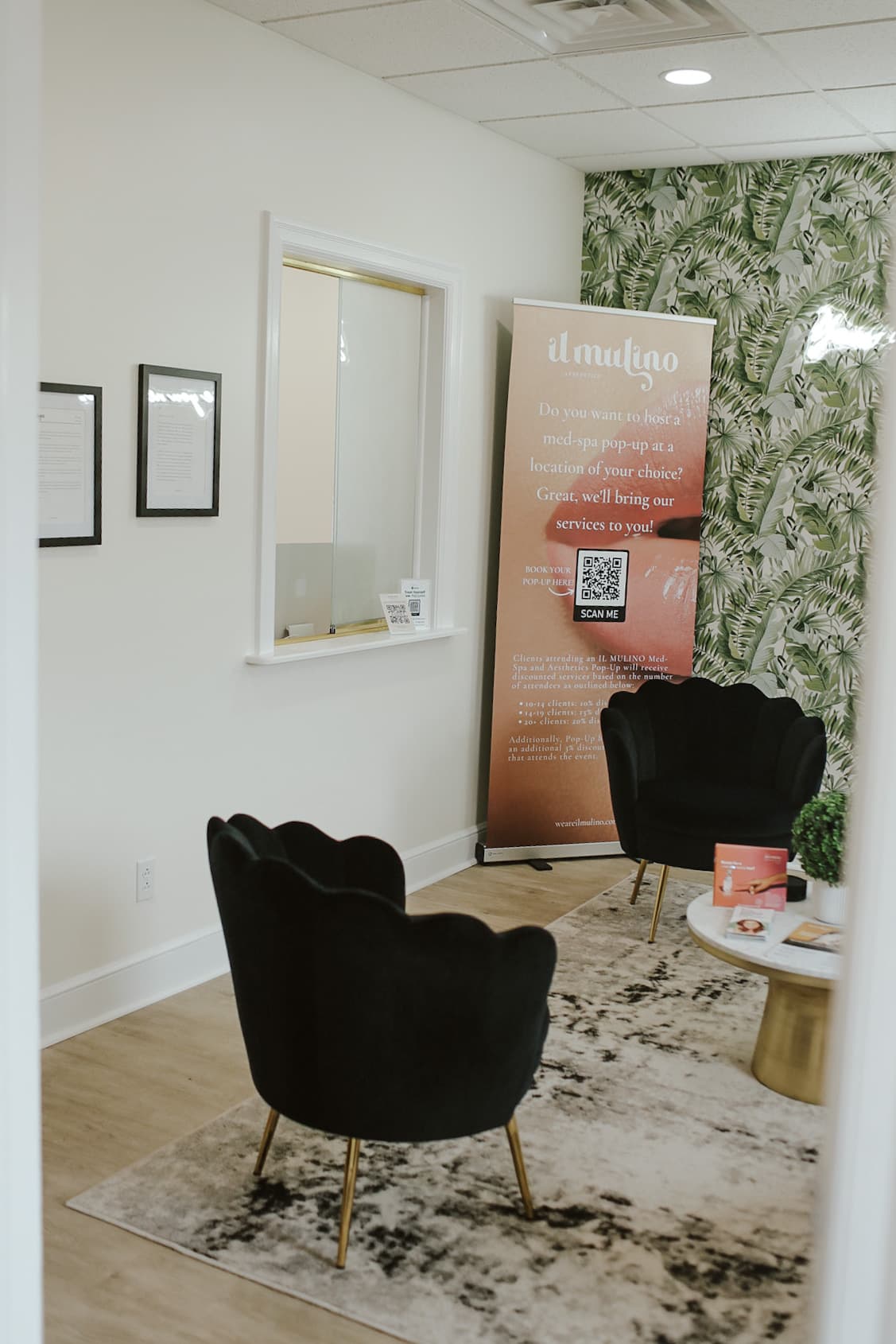
Calyxe did not begin as an idea. It began as a real med spa we built and ran ourselves, with every regulatory, operational, and financial knot that comes with one. Il Mulino Aesthetics is how we learned to do this the hard way, and it is the reason we became the partner we wish had existed when we started.
A note on what this is ·

We set out to build something bigger than a storefront
We came into this from personal care — barbershops and salons — self-made entrepreneurs at the core. No medical pedigree, no MBA. What we arrived with was operating instinct: years of running service businesses end to end, building brands and client bases from nothing, and a willingness to learn what we did not yet know. What we had already proven in one industry was that we could build an operation people wanted to come back to. A med spa was the next, bigger application of that same skill set.
The ambition was never a single location. We wanted to create real impact in our local market: good jobs, a place where people build a career rather than clock in, and growth that moved everyone forward at once. If it only made money but did not move people, it would not have been worth doing.
What we assumed would be simple, and was not
The clinical side. We understood enough to think we knew what it would take. What we learned instead was that every seemingly surface-level item had an iceberg beneath it. Credentialing, physician oversight, scope of practice, provider recruitment, product and inventory: each one looked manageable from the outside and each one had to be sorted out at a depth we did not see coming. Underneath all of it sat a subtler challenge, the gap between owning the brand and earning clinical trust. We could build the brand. Trust in a medical setting has to be earned a different way.
The bigger shift was the nature of the business itself. A med spa sells a discretionary luxury, not a necessity. Nobody needs what we offer the way they need a haircut, and that changes everything: how you acquire clients, how you keep them, and how you build a brand people choose to return to when they could just as easily not. There is a real cost to acquire every client, and that cost has to stay front of mind constantly.
If we are honest, the part that humbled us most was the financial side. A haircut price is a haircut price. In aesthetic medicine, the number that hits your account is a long way from the number on the price tag. The cost to acquire each client, the price the market will bear for each service, and the cost of goods underneath every treatment all pull against one another — and beneath them runs the gross-to-net waterfall, every deduction and every leak between gross revenue and net dollars. Understanding how those pieces move together is the difference between a business that looks profitable and one that actually is. That was the steepest part of the climb.
You are not solving one hard thing. You are solving twelve at once
The hardest parts had nothing to do with treating a single patient. The state regulatory constraints came first, shaping every decision downstream. Then entity structure, and specifically the relationship between the management entity and the clinical entity, an architecture that is not intuitive and creates exposure you do not discover until it is expensive. Finding the right medical director was its own mountain, not just identifying someone credentialed but building the relationship. On top of all of it sat the disciplines below, each its own world.
None of it was a single problem to solve. It was a dozen interconnected ones, all at once, in a language we did not yet speak, with no map. And the interconnection is the trap: you make an assumption about one item so you can move forward on the others, then that assumption changes or proves wrong, and every decision built on it comes apart with it. It took a very long time to understand how the factors move one another — and it is exactly that understanding that finally makes the whole thing navigable. That is the part nobody warns you about.

Where there was no playbook
Sourcing and keeping clinical talent when you are not a clinician yourself does not come with a manual. The deeper challenge was building revenue beyond consumer services, standing up additional centers of impact instead of betting everything on one stream. There was no template for how a brand like ours should diversify, so we designed it ourselves: what to build, when to build it, and how each new vertical should reinforce the others rather than dilute focus. Every one of those calls was made without a reference point.
What we underestimated the first time
It was not the goals. We came in with a strong sense of goal-setting and how to fragment goals across a team. What we greatly underestimated was uptake. Most people who work in medicine have never been handed a business context — goal setting, scorecards, annual reviews, the things employees in corporate America take entirely for granted were brand new to our teams. That is no knock on them. It is a structural gap, and bridging it became our job. So we built the infrastructure to translate vision into something each person could act on: scorecards, deliberate communication, consistent one-to-ones, and a clear path forward for every provider, delivered in pieces they can chip away at week over week.
A goal nobody can see or measure is not a goal. It is a wish. What gets measured, gets managed.
That rebuilt system is one of the things we now bring to the table fully formed.
Over a quarter million dollars before we opened the doors, and almost none of it touched patient care
It went into learning compliance and regulations, structuring the entity, building rapport with a medical director, securing licensing, standing up operations, and managing product and inventory. An enormous share of our earliest capital and time was spent simply earning the right to operate, solving complexity the patient never sees and never benefits from directly.
And here is what compounds it: that money must be spent. You have no choice about being compliant. You do have a choice about marketing. So every time the question was “where should we spend the money we have?”, compliance, licensing, and insurance won the arm wrestle — and growth waited.
That is the hidden tax of entering this space, and it is far heavier than anyone expects. It is also the exact tax Calyxe was built to remove, so the next owner spends their capital on growth and care, not on tuition for lessons we have already paid for.
Was there a point where we thought there had to be a better way? Constantly, and from very early on. We kept wishing we had a subject-matter expert who could come in and hold our hands while we found our footing. We are quick learners, and we understand that speed is a weapon and we use it fully. Even moving fast, we knew that a team of experts to show us the way would have saved us a year or two of headaches and hard-won mistakes. That gap, the expert we wished existed when we started, is the entire reason Calyxe exists.
We did not build Calyxe from theory. We built it from the exact climb we just described, so the next practitioner does not have to make it alone.

The playbook is not the hard part. The sequence is
You can read about compliance, entity structure, and scope of practice. Until you are living it, you do not know what has to happen before what, or which mistakes are recoverable and which ones cost you a year — and a lost year gets very expensive once you have signed a lease and the fixed costs are running whether you are open or not. That is the lesson you cannot get from the outside.
The other one: this is a people business wearing a clinical coat. Two things move everything, consultation and education. Get those right and the treatment plan writes itself, because it is built around the client's real pain and the outcome they are actually dreaming about. No book teaches you how much of the work is emotional rather than technical. You learn it by doing it.
The biggest surprise running a real med spa day to day was human. The clinical skill was rarely the bottleneck. Leadership was. There are many talented people waiting to be led, and many practices that do not have the patience to lead them. We built everything around two foundations for our providers, consultation and education, and the rest followed.
The one thing we wish we had on day one
A turnkey playbook we owned outright, start to finish. Stage-gated, so you cannot skip ahead: you finish step one before step two, two before three. It would spell out exactly what to do and, just as importantly, what not to do at each stage. Most of what we lost early on was not lost to bad decisions. It was lost to not knowing the order of operations. A book like that does not just save money. It saves the year you would otherwise spend learning the sequence the hard way.

Every framework we offer exists because we needed it first and did not have it
Almost all of those lessons shaped how Calyxe works today. Three shaped it most.
The book we wished for
The turnkey playbook became what we deliver: stage-gated, sequenced, with what to do and what to avoid at every step, so the order of operations is handed over rather than discovered.
A leadership business
Because the bottleneck was leadership and not clinical skill, we do not just hand owners systems. We coach the people running them, the same way someone should have coached us.
The real numbers, up front
The gross-to-net waterfall we learned the hard way is built into the foundation we set, so partners understand their real economics from day one instead of discovering them eighteen months in.
We do not disappear once a plan is handed over. We stay in it, the way someone should have stayed in it with us. We have opened three medical spas. We are not consultants advising on a business we have never run. We know aesthetic medicine and we know business, and that combination is rare. When you work with us, you can be confident we speak the same language you do and have sat in the chair you are sitting in. That is the difference between advice and partnership.
Il Mulino today is the evidence the model works
Light-years from the early days. The real growth is the buy-in and the culture underneath the numbers, but the numbers tell their own story.
Providers across the organization, heavy on PAs and NPs
Medical spas opened and operated firsthand
Earned by top-performing providers
Taken home by top performers
Provider earnings reflect top performers and are shared to set accurate expectations. Net Promoter Score at Il Mulino is qualitatively very high. Cash reserves now fund the latest equipment, top vendors, and ad spend across multiple markets, so the business plays offense, investing ahead of growth rather than scrambling to catch up to it.
“Do not do this alone. The money you lose going it alone is often the exact money you could have paid someone to reach a net positive far sooner.”
The honest answers we wish we had at the start
You do not have to learn the sequence the hard way
We became the partner we wish we had. If you are standing where we once stood, we would be glad to talk it through with you.