Why most med spas fail in year two (and how to build for longevity)
Most med spas do not fail in year one. They fail in year two. Learn why operational gaps, retention issues, and financial blind spots derail practices and how to build for longevity.
Most med spas do not fail in year one. They fail in year two. Learn why operational gaps, retention issues, and financial blind spots derail practices and how to build for longevity.

Jordan Mercer
Year one of a med spa is often the most exciting and the most forgiving. There is momentum from a new opening, novelty that drives early patient volume, and the energy of building something from scratch. Most of the hard operational lessons have not yet arrived.
Year two is different. The novelty fades. Referrals slow if retention systems were not built. Staff turnover surfaces structural weaknesses. Revenue that looked strong in month six looks inconsistent in month eighteen. And for many practices, the gap between what was planned and what was built becomes impossible to ignore.
This is not a pessimistic view of the industry. It is an honest one. The medical aesthetics market is growing, the demand is real, and the opportunity for well-built practices is significant. But the failure rate in year two is high precisely because most practices are built for launch, not for longevity.
Here is what that actually looks like, and what separates the practices that last from the ones that do not.
The launch trap: Why opening day success does not guarantee year two
Most med spa founders spend the majority of their pre-opening energy on the things that are visible: the buildout, the equipment, the brand, the treatment menu. These matter. But they are the front end of a much larger operational system, and when the back end is not built to match, the visible things start to break down.
The launch trap is the pattern of prioritizing presentation over infrastructure. It produces practices that look polished on opening day but are running on improvisation six months later. When a key team member leaves, there is no system to replace them cleanly. When a compliance audit happens, there are gaps that cannot be quickly explained. When patient volume grows, quality becomes inconsistent because there was never a standard to return to.
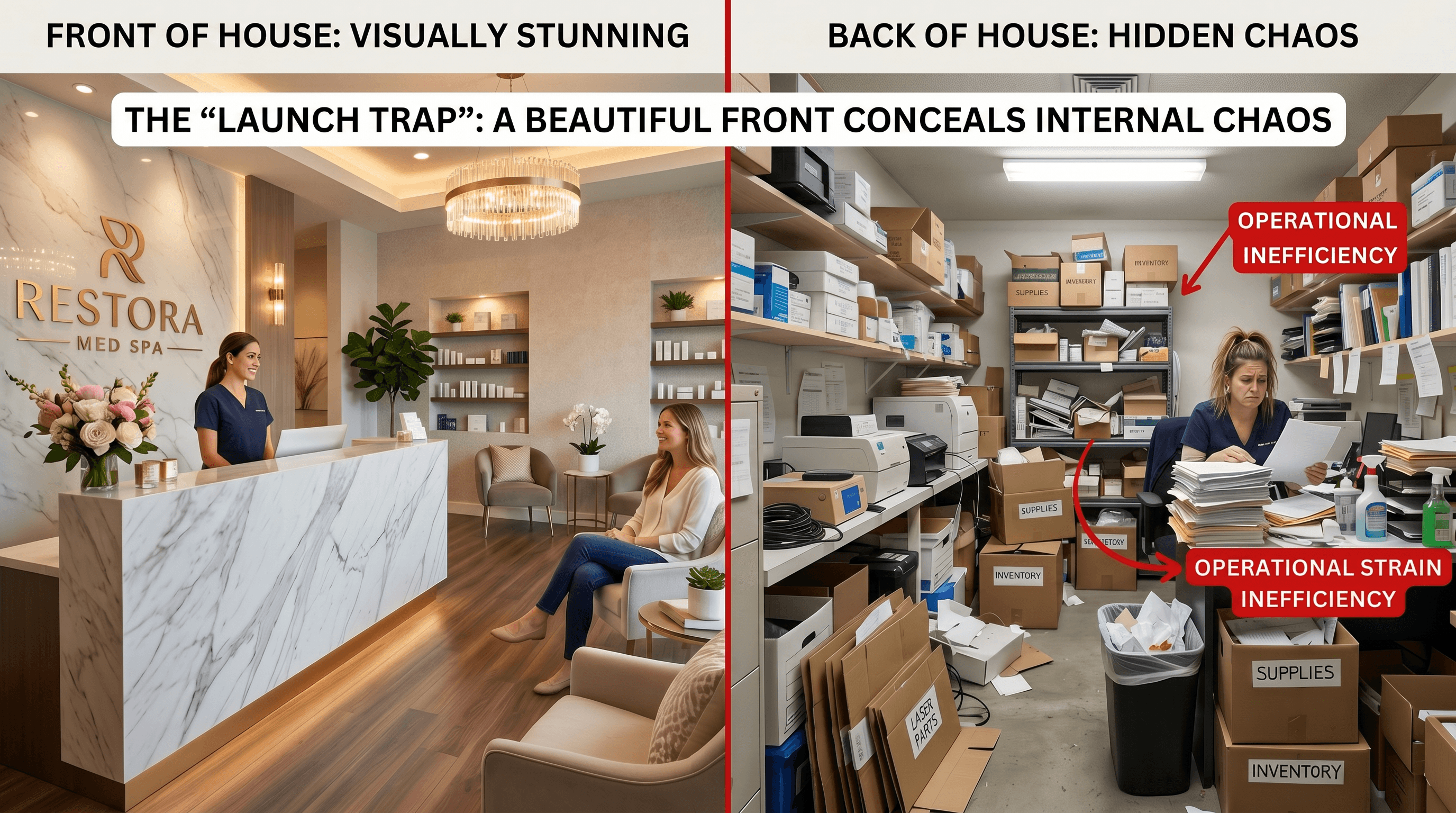
Building for launch is not wrong. Building only for launch is the problem.
What does year two of a med spa actually test?
The challenges that surface in year two are almost always operational, not market-related. The market for medical aesthetics is strong. That is not the variable. What year two tests is whether the practice was built with the infrastructure to sustain growth.
Patient retention:
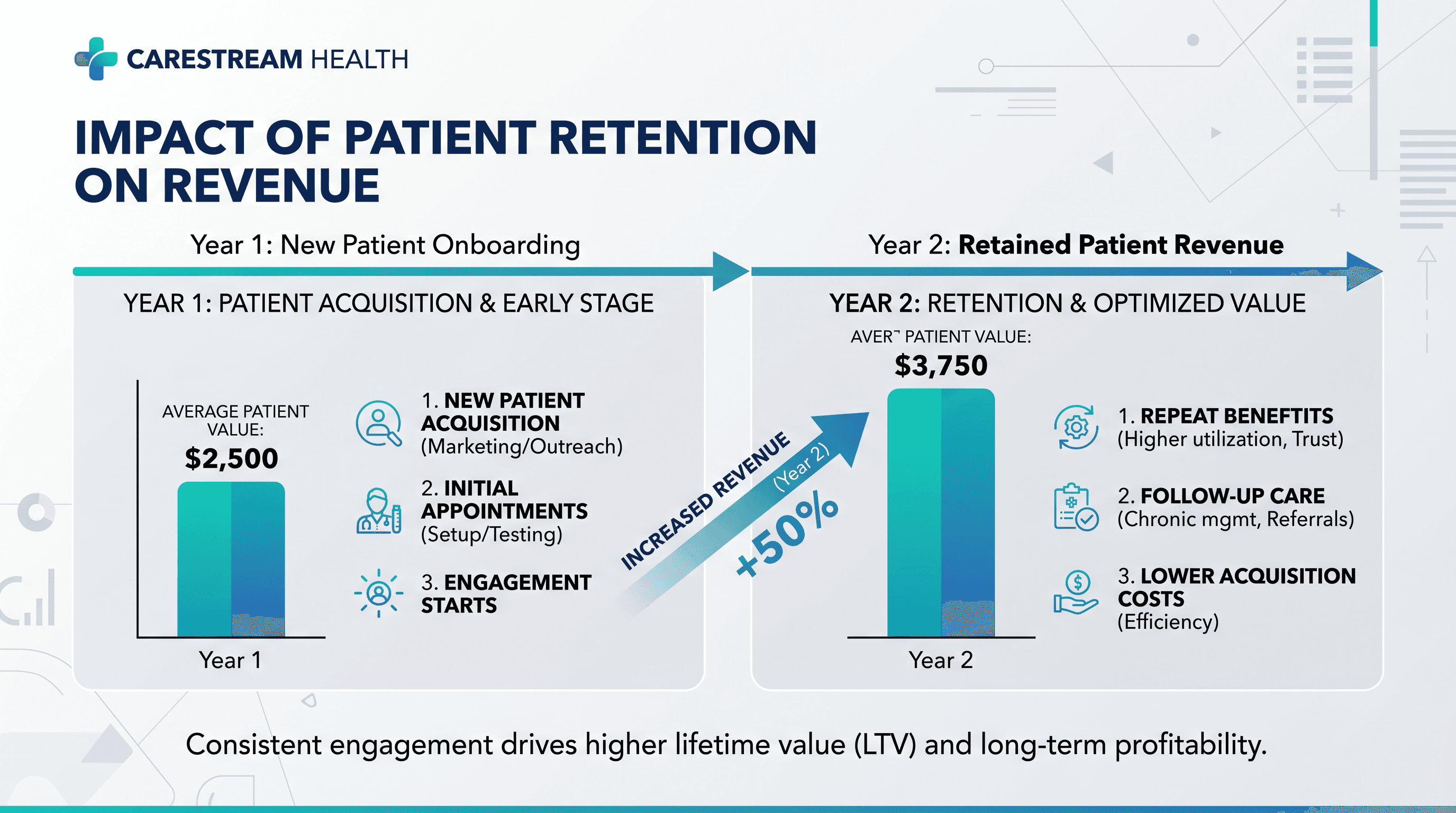
A new med spa can survive on new patient acquisition for a period of time. Eventually, the cost of continuously replacing patients who do not return becomes unsustainable. Retention requires intentional systems, including follow-up protocols, loyalty frameworks, and communication cadences, that most practices either never built or abandoned when things got busy.
Financial clarity:
Many med spa owners reach year two without a clear picture of their unit economics. They know revenue. They may not know the true cost per treatment, the margin by service line, or the break-even point for each device. Without that clarity, growth decisions become guesswork. And guesswork at scale is expensive.
Staff stability:
High turnover in aesthetics is common, but it is not inevitable. Practices that built strong hiring frameworks, clear role definitions, and documented onboarding processes retain people at significantly higher rates than those that hired reactively and trained informally. When year two brings staff departures, and it often does, the practices with systems recover. The ones without them scramble.
Compliance maintenance:
State regulations evolve. Supervision requirements change. New treatment modalities raise new questions about scope of practice. Practices that treat compliance as a one-time pre-opening task find themselves out of step with current requirements in year two. Practices that build ongoing compliance review into their operations stay ahead of it.
The systems that separate lasting med spas from the rest
There is no single thing that determines whether a med spa survives year two. It is a combination of interconnected systems, each one reinforcing the others.
Clinical SOPs:
Every treatment protocol, every informed consent process, every adverse event response should be documented and consistently followed. This is not about bureaucracy. It is about being able to maintain clinical quality as volume grows and team composition changes.
Financial infrastructure:
A real financial system means more than bookkeeping. It means understanding your cash flow cycle, knowing your key metrics by service line, and having the reporting in place to make informed decisions about hiring, equipment investment, and marketing spend.
HR and staffing frameworks:
This includes written job descriptions, documented onboarding processes, performance review structures, and clear policies that protect both the practice and the team. It also includes a medical director agreement that is specific, compliant, and reflective of the actual supervision occurring in the practice.
Patient experience systems:
Retention does not happen by accident. It is the result of a deliberately designed patient journey, from first contact through follow-up, that makes returning feel natural and valuable. That design has to be built and maintained, not assumed.
Vendor and equipment management:
Understanding the true cost and ROI of each device, maintaining service agreements, and managing consumable inventory are operational disciplines that many practices never formalize. In year two, when device issues or supply disruptions occur, the practices without these systems feel the impact disproportionately.

What does “Built for longevity” actually mean for a med spa?
It does not mean perfection on day one. No practice achieves that, and anyone who tells you otherwise has not actually operated one.
It means building with the awareness that the business you are launching will look very different in 24 months, and designing systems that can absorb that change rather than break under it. It means making decisions before opening that your future self will be grateful for: the compliance structure that holds up under scrutiny, the staffing framework that makes good hiring repeatable, the financial systems that give you clarity when growth creates complexity.
The practices that thrive in year two did not get lucky. They made different decisions in year zero.
A different starting point
At Calyxe, we work with clients from the earliest stages of planning, not because we want to extend the engagement, but because the decisions made before a practice opens determine almost everything that follows.
If you are in the planning phase and want an honest assessment of whether what you are building is designed for longevity, we are happy to have that conversation. No pressure, no pitch. Just clarity on where you stand and what would make your foundation stronger.
Frequently asked questions
Why do so many med spas fail in year two?
Most med spas fail in year two because they were built for launch rather than for long-term operations. Common causes include lack of patient retention systems, poor financial visibility, staff turnover with no documented processes to absorb it, and compliance gaps that were never addressed after opening.
What is the most important system a med spa needs to survive year two?
There is no single system, but patient retention is often the highest-leverage area. A practice that can keep existing patients returning spends far less on acquisition and builds more predictable revenue. Retention requires intentional design of the patient journey and consistent follow-up protocols.
How does staff turnover affect med spa survival in year two?
When practices lack documented processes and onboarding frameworks, staff departures create significant disruption. Institutional knowledge walks out the door with the employee, quality becomes inconsistent, and the owner often has to step back into operational roles they had moved away from. Practices with documented systems recover from turnover far more efficiently.
What financial metrics should a med spa be tracking in year two?
Key metrics include cost per treatment, margin by service line, cost per patient acquisition, patient lifetime value, device ROI, and cash flow by month. Without these, growth and investment decisions are made with incomplete information.
Can an existing med spa fix operational gaps without shutting down?
Yes. Operational systems like SOPs, staffing frameworks, and financial reporting can be layered into a running practice without disrupting patient care. The process requires prioritization and a realistic timeline, but it does not require starting over.
Year one of a med spa is often the most exciting and the most forgiving. There is momentum from a new opening, novelty that drives early patient volume, and the energy of building something from scratch. Most of the hard operational lessons have not yet arrived.
Year two is different. The novelty fades. Referrals slow if retention systems were not built. Staff turnover surfaces structural weaknesses. Revenue that looked strong in month six looks inconsistent in month eighteen. And for many practices, the gap between what was planned and what was built becomes impossible to ignore.
This is not a pessimistic view of the industry. It is an honest one. The medical aesthetics market is growing, the demand is real, and the opportunity for well-built practices is significant. But the failure rate in year two is high precisely because most practices are built for launch, not for longevity.
Here is what that actually looks like, and what separates the practices that last from the ones that do not.
The launch trap: Why opening day success does not guarantee year two
Most med spa founders spend the majority of their pre-opening energy on the things that are visible: the buildout, the equipment, the brand, the treatment menu. These matter. But they are the front end of a much larger operational system, and when the back end is not built to match, the visible things start to break down.
The launch trap is the pattern of prioritizing presentation over infrastructure. It produces practices that look polished on opening day but are running on improvisation six months later. When a key team member leaves, there is no system to replace them cleanly. When a compliance audit happens, there are gaps that cannot be quickly explained. When patient volume grows, quality becomes inconsistent because there was never a standard to return to.
Building for launch is not wrong. Building only for launch is the problem.
What does year two of a med spa actually test?
The challenges that surface in year two are almost always operational, not market-related. The market for medical aesthetics is strong. That is not the variable. What year two tests is whether the practice was built with the infrastructure to sustain growth.
Patient retention:
A new med spa can survive on new patient acquisition for a period of time. Eventually, the cost of continuously replacing patients who do not return becomes unsustainable. Retention requires intentional systems, including follow-up protocols, loyalty frameworks, and communication cadences, that most practices either never built or abandoned when things got busy.
Financial clarity:
Many med spa owners reach year two without a clear picture of their unit economics. They know revenue. They may not know the true cost per treatment, the margin by service line, or the break-even point for each device. Without that clarity, growth decisions become guesswork. And guesswork at scale is expensive.
Staff stability:
High turnover in aesthetics is common, but it is not inevitable. Practices that built strong hiring frameworks, clear role definitions, and documented onboarding processes retain people at significantly higher rates than those that hired reactively and trained informally. When year two brings staff departures, and it often does, the practices with systems recover. The ones without them scramble.
Compliance maintenance:
State regulations evolve. Supervision requirements change. New treatment modalities raise new questions about scope of practice. Practices that treat compliance as a one-time pre-opening task find themselves out of step with current requirements in year two. Practices that build ongoing compliance review into their operations stay ahead of it.
The systems that separate lasting med spas from the rest
There is no single thing that determines whether a med spa survives year two. It is a combination of interconnected systems, each one reinforcing the others.
Clinical SOPs:
Every treatment protocol, every informed consent process, every adverse event response should be documented and consistently followed. This is not about bureaucracy. It is about being able to maintain clinical quality as volume grows and team composition changes.
Financial infrastructure:
A real financial system means more than bookkeeping. It means understanding your cash flow cycle, knowing your key metrics by service line, and having the reporting in place to make informed decisions about hiring, equipment investment, and marketing spend.
HR and staffing frameworks:
This includes written job descriptions, documented onboarding processes, performance review structures, and clear policies that protect both the practice and the team. It also includes a medical director agreement that is specific, compliant, and reflective of the actual supervision occurring in the practice.
Patient experience systems:
Retention does not happen by accident. It is the result of a deliberately designed patient journey, from first contact through follow-up, that makes returning feel natural and valuable. That design has to be built and maintained, not assumed.
Vendor and equipment management:
Understanding the true cost and ROI of each device, maintaining service agreements, and managing consumable inventory are operational disciplines that many practices never formalize. In year two, when device issues or supply disruptions occur, the practices without these systems feel the impact disproportionately.
What does “Built for longevity” actually mean for a med spa?
It does not mean perfection on day one. No practice achieves that, and anyone who tells you otherwise has not actually operated one.
It means building with the awareness that the business you are launching will look very different in 24 months, and designing systems that can absorb that change rather than break under it. It means making decisions before opening that your future self will be grateful for: the compliance structure that holds up under scrutiny, the staffing framework that makes good hiring repeatable, the financial systems that give you clarity when growth creates complexity.
The practices that thrive in year two did not get lucky. They made different decisions in year zero.
A different starting point
At Calyxe, we work with clients from the earliest stages of planning, not because we want to extend the engagement, but because the decisions made before a practice opens determine almost everything that follows.
If you are in the planning phase and want an honest assessment of whether what you are building is designed for longevity, we are happy to have that conversation. No pressure, no pitch. Just clarity on where you stand and what would make your foundation stronger.
Frequently asked questions
Why do so many med spas fail in year two?
Most med spas fail in year two because they were built for launch rather than for long-term operations. Common causes include lack of patient retention systems, poor financial visibility, staff turnover with no documented processes to absorb it, and compliance gaps that were never addressed after opening.
What is the most important system a med spa needs to survive year two?
There is no single system, but patient retention is often the highest-leverage area. A practice that can keep existing patients returning spends far less on acquisition and builds more predictable revenue. Retention requires intentional design of the patient journey and consistent follow-up protocols.
How does staff turnover affect med spa survival in year two?
When practices lack documented processes and onboarding frameworks, staff departures create significant disruption. Institutional knowledge walks out the door with the employee, quality becomes inconsistent, and the owner often has to step back into operational roles they had moved away from. Practices with documented systems recover from turnover far more efficiently.
What financial metrics should a med spa be tracking in year two?
Key metrics include cost per treatment, margin by service line, cost per patient acquisition, patient lifetime value, device ROI, and cash flow by month. Without these, growth and investment decisions are made with incomplete information.
Can an existing med spa fix operational gaps without shutting down?
Yes. Operational systems like SOPs, staffing frameworks, and financial reporting can be layered into a running practice without disrupting patient care. The process requires prioritization and a realistic timeline, but it does not require starting over.