May 4, 2026
What an MSO structure actually means for your med spa (and why it matters)
Not sure what an MSO means for your med spa? This guide breaks down the Management Services Organization model, how it works, who needs it, and what to watch out for.
 Jordan Mercer
Year one of a med spa is often the most exciting and the most forgiving. There is momentum from a new opening, novelty that drives early patient volume, and the energy of building something from scratch. Most of the hard operational lessons have not yet arrived.
Year two is different. The novelty fades. Referrals slow if retention systems were not built. Staff turnover surfaces structural weaknesses. Revenue that looked strong in month six looks inconsistent in month eighteen. And for many practices, the gap between what was planned and what was built becomes impossible to ignore.
This is not a pessimistic view of the industry. It is an honest one. The medical aesthetics market is growing, the demand is real, and the opportunity for well-built practices is significant. But the failure rate in year two is high precisely because most practices are built for launch, not for longevity.
Here is what that actually looks like, and what separates the practices that last from the ones that do not.
Why does the MSO structure exist?
Medical spas occupy a specific regulatory position. They offer aesthetic treatments, including injectables, laser services, chemical peels, and body contouring, that are classified as medical procedures in most states. That classification means they fall under the same regulatory framework as other medical practices, including rules about who can own and control a medical business.
In most states, a medical practice must be owned by a licensed physician, or in some states, another licensed clinical provider. This requirement creates a structural challenge for the many people who want to build a med spa business without holding a medical license. It also creates complexity for clinicians who want investors, business partners, or operators involved in their practice without running afoul of regulations around physician ownership and corporate practice of medicine.
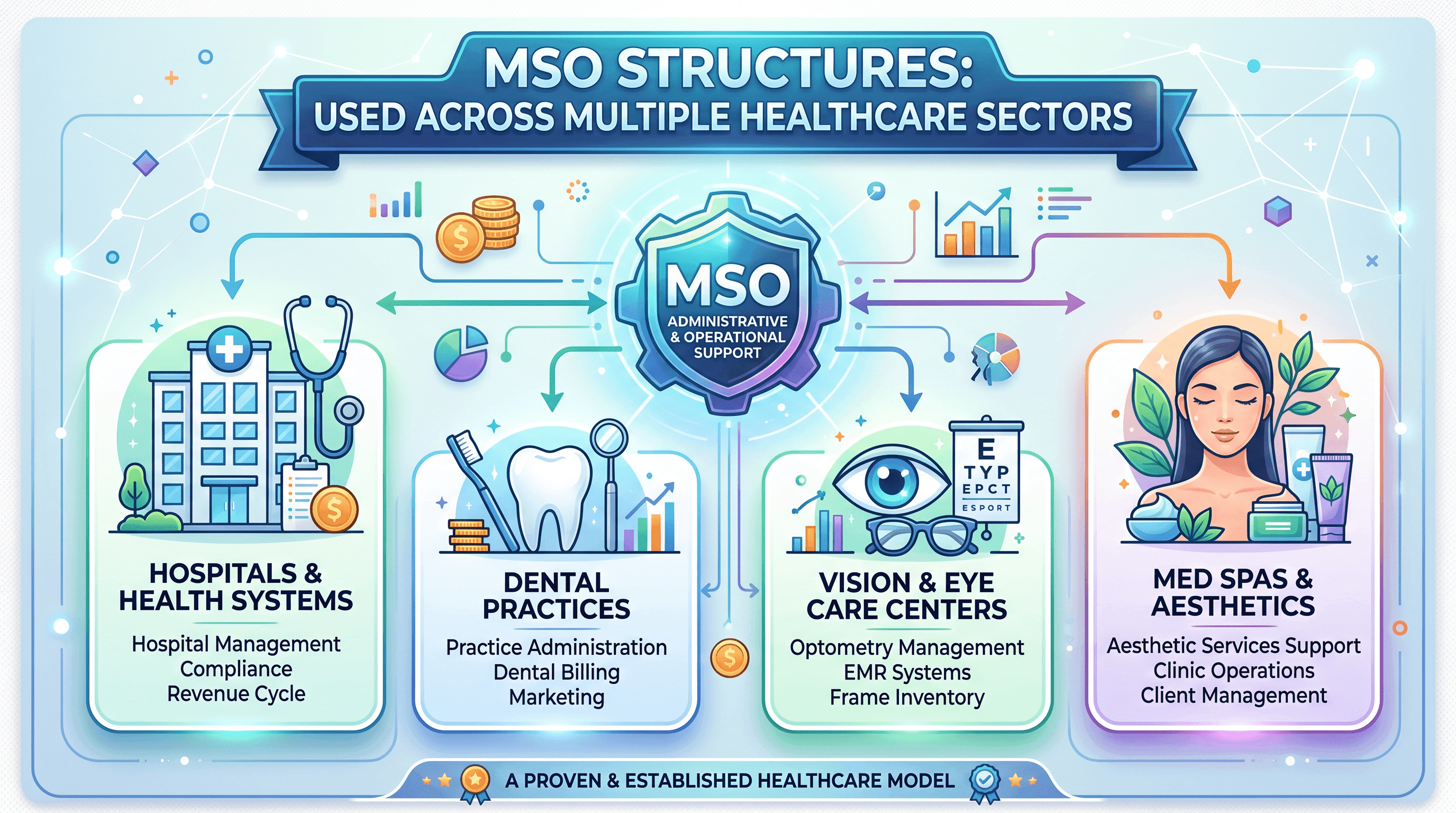
The Management Services Organization model was developed to address this. It is not a workaround or a gray-area tactic. It is a legally recognized structure used across the healthcare industry, including in hospitals, dental practices, vision centers, and specialty clinics, specifically because the challenge of separating business management from clinical ownership is not unique to med spas.
What is an MSO and what does it actually do?
An MSO is a separate business entity, typically structured as an LLC, that handles the non-clinical operations of a medical practice. This includes:
- Marketing and business development
- Human resources and staffing support
- Technology and software systems
- Facilities management
- Financial reporting and revenue cycle management
- Vendor relationships and procurement
- Training and operational systems
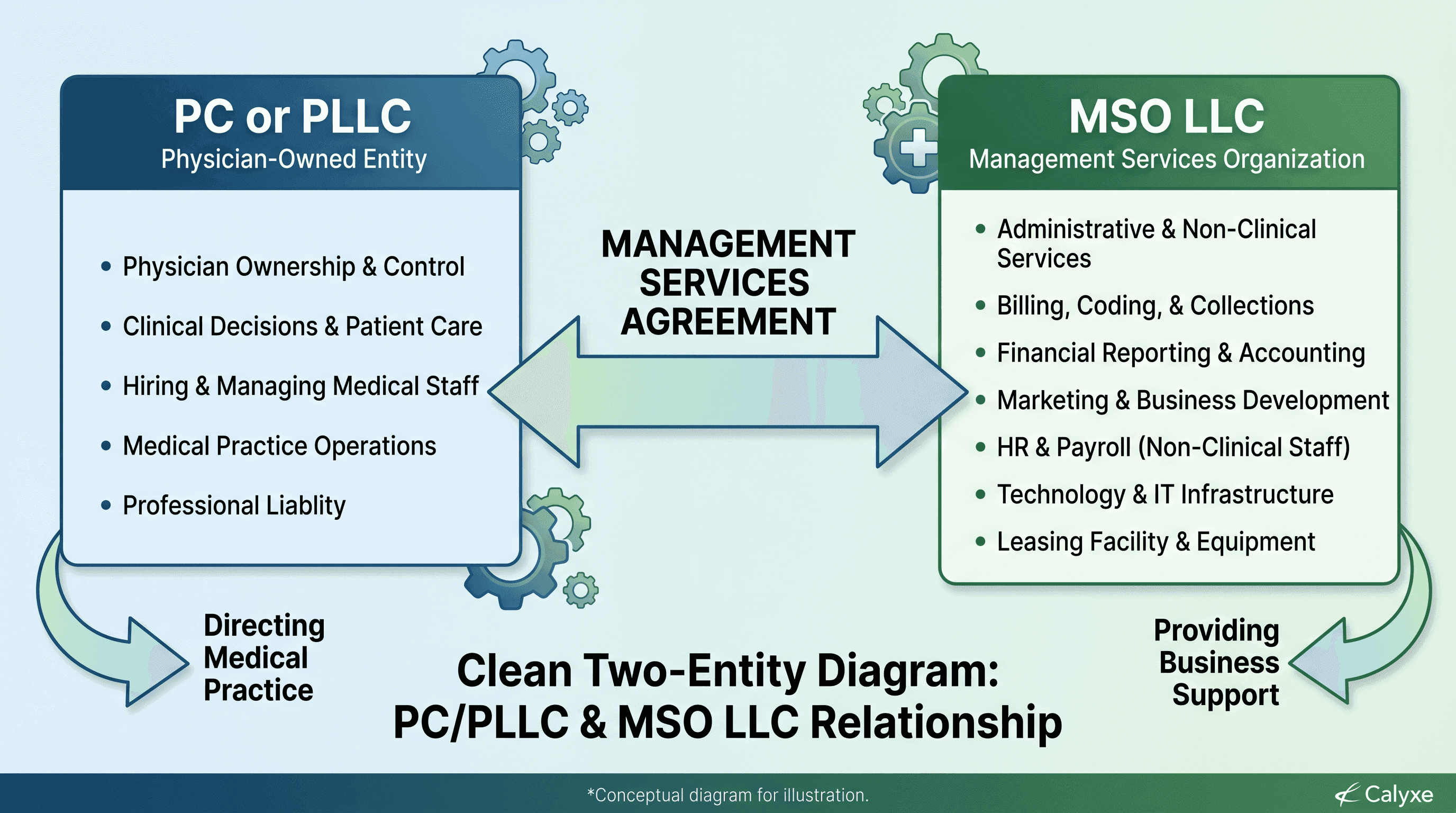
The MSO contracts with the medical practice, which is owned by the physician, to provide these services in exchange for a management fee. The physician retains full ownership of the medical entity and full control over clinical decisions. The MSO operates everything else under a detailed Management Services Agreement.
This separation is the core of the structure. The clinical entity and the management entity are legally distinct. Their relationship is governed by contract. The physician is not an employee of the MSO. The MSO is a service provider to the physician's practice.
How does an MSO work in practice?
In a properly structured MSO arrangement, there are two entities:
The Professional Corporation (PC) or Professional LLC (PLLC):
This is the medical entity, owned by the physician. It holds the medical license, employs clinical staff, and is legally responsible for all clinical care. In some states, this entity is called a Professional Corporation. In others, it may be structured differently. The key point is that it is owned and controlled by a licensed physician.
The Management Services Organization (LLC):
This is the business entity. It can be owned by anyone, including a non-physician entrepreneur, an investor, or a combination of parties. It provides all non-clinical operational services to the PC under contract and receives a management fee in return. That fee is typically structured to reflect the fair market value of the services provided.
The Management Services Agreement between the two entities is the legal backbone of the arrangement. It defines what services the MSO provides, how the fee is calculated, what authority each party holds, and how the relationship can be modified or terminated.
Common misconceptions about the MSO model
“The MSO lets a non-physician own a medical practice.”
Not exactly. The medical practice is still owned by the physician. What the MSO structure allows is for a non-physician to own the management company that supports the practice. These are legally distinct. The physician retains clinical authority. The MSO holds operational control over non-clinical functions.
“Any MSO structure is compliant.”
This is where many practices get into trouble. The MSO structure is legitimate when properly set up, with a genuine arms-length relationship between the two entities, fair market value fees, and a Management Services Agreement that reflects actual operational reality. When the structure is a formality, when the physician has no real authority, or when the fee arrangement does not reflect market value, it can be considered a sham structure and expose both parties to significant legal risk.
“You only need an MSO if you are not a physician.”
Physicians can also benefit from the MSO structure. It can be used to separate the clinical practice from business operations, protect personal assets, facilitate investment or partnership arrangements, and create a scalable infrastructure for multi-location growth.
What should you watch out for when setting up an MSO?
The MSO structure is only as sound as its implementation. The most common failure points are:
Inadequate documentation. The Management Services Agreement needs to be specific, comprehensive, and reflective of the actual relationship. A generic template or a brief contract is not sufficient.
Fee structures that do not reflect fair market value. If the management fee is structured in a way that effectively transfers all practice revenue to the MSO, it raises serious questions about the legitimacy of the arrangement. Fees should be grounded in the actual market value of the services provided.
Physician authority that exists only on paper. The physician must genuinely control clinical decisions. If the operational reality does not match the structure on paper, the arrangement is at risk.
State-specific compliance. MSO structures are governed by state law, and the specifics, including what is permitted, how the agreement must be structured, and what authority the physician must maintain, vary by state. A structure that works in one state may not be compliant in another.
Is an MSO right for your med spa?
That depends on your ownership situation, your state's regulatory environment, and how you intend to structure your business and any future growth. Not every med spa requires an MSO. Some are owned entirely by a physician and have no need for the structure. Others are built from the beginning with the intention of separating business and clinical ownership, in which case the MSO is essential.
The most important thing is to make this decision with accurate information about your specific state's requirements and the realistic options available to you, before you set up any entity, sign any agreements, or bring any partners into the business.
At Calyxe, we have worked through this structure firsthand, not just in advising clients, but in building our own practice. We know what a properly implemented MSO looks like, where the common pitfalls are, and what questions to ask before committing to a structure.
If you want to understand whether an MSO is the right approach for your situation, that conversation starts with no obligation and no pitch. Just a clear-eyed look at your options.
Frequently asked questions
What does MSO stand for in a med spa context?
MSO stands for Management Services Organization. It is a separate business entity that manages the non-clinical operations of a medical practice, such as marketing, HR, facilities, and financial systems, while the physician-owned clinical entity handles all patient care and medical decisions.
Can a non-physician own a med spa through an MSO?
A non-physician cannot own the medical entity of a med spa, but they can own the Management Services Organization that operates all non-clinical functions. This allows non-physicians to have a significant ownership and operational stake in the business without violating state regulations around physician ownership of medical practices.
Do you need a lawyer to set up an MSO for a med spa?
Yes. Because MSO structures are governed by state law and involve complex contractual relationships between two separate legal entities, working with a healthcare attorney who is familiar with your specific state's regulations is essential. A poorly drafted Management Services Agreement can undermine the entire structure.
What is the Management Services Agreement?
The Management Services Agreement, or MSA, is the contract between the MSO and the physician-owned medical entity. It defines the scope of services the MSO provides, how the management fee is calculated, what authority each party holds, and how the relationship can be changed or ended. It is the legal foundation of the arrangement.
Is an MSO structure the same in every state?
No. MSO structures are governed by state law, and what is permissible varies significantly from state to state. Before setting up an MSO, you need a state-specific legal review to confirm the structure is compliant in the jurisdiction where you are operating.